Showing posts with label Pagan King. Show all posts

The Test


In a few short hours I'll be setting out on the longest journey of the season and the first of the final two. I'll be traveling over 50 miles filming and capturing images along the way for "The Battle With the Furies" chapter of my story. Beyond the journey itself - I'll be doing it all without any sleep.

I always get restless when I get close to the end of my ongoing quest. A lingering sense of urgency, anxiety, nervousness. I've been on enough adventures to know what I am about to go through - to know that much of it is going to hurt.

That's part of the deal.

My story is one of suffering and sacrifice. The old kind. Something most modern pagans try their best to run away or hide from. None of them having the slightest clue what it takes to "honor the gods" they claim to follow and serve. Easy to talk of a path, not so easy to walk one.

As before, once again Zeus interfered with the set task. Sending thunderstorms across the area, delaying the journey for three days. But the clouds have parted and soon the next steps of the journey will be taken.

I'll be traveling far to the east, further than I have ever ventured before, into a forest steeped in history and urban legend as I wrote of in the previous entry. I'll set out hours before sunrise in order to make it to my destination with enough daylight left to do what is to be done. The days are getting shorter, the nights colder and the area I am traveling into is not the type of place one wants to have to pass through after dark.

A few short hours away from sacrificing more of my body and soul - glorious.

For now, a hot shower and a hot coffee. Then it will be time to check my gear and prepare to take on a beast of a challenge, worthy of the Furies themselves.

Lightning in a Bottle - Thunder Wine

I woke up before down this morning to flashes of lightning and claps of thunder and I welcomed it. I've been in and out, playing in the storm, soaking up the rain all morning.

Completing the challenges on the Path of Gaia I returned home to check in on another challenge I had committed to some time back. The challenge was to fill a crystal bowel with less than a cup of rain water from every thunderstorm of the season until the Greek vase I was storing it in was full. The rule was that there had to be both thunder and lightning present during the gathering of the water. Reason being, lightning alters the chemical composition of rain water. Without lightning there literally would not be any life on the planet. It took a dozen thunderstorms, filling the crystal bowel one raindrop at a time, in order to fill the vase.

 Once I had collected the storm water the trick was to turn the water into wine. And so I set about brewing, mixing, filtering, fermenting, and creating a perfectly balanced sweet amber red wine from the storm water. Not red in the traditional sense. This wine happens to be made primarily of honey. The red tint comes from the pomegranate and herbs I used during the fermentation process. The result has come to be a rather potent potion and a measure of that exact potion can be seen here:


This small measure taken from the main stock is enjoyed (no more and an ounce at a time) on days like today when there is a thunderstorm present. Some is offered up as an offering to Hera upon the altar, while the rest is to be sealed in a very special, hand etched lightning bolt wine bottle. Once corked the cork will be sealed with a special red wax embedded with a fulgurite crystal (a petrified lightning bolt).

This wine has a sweet start with a spicy finish that lingers. it is the perfect embodiment of the elements from which it was created. It also happens to be a one of a kind wine. This wine cannot be reproduced. This one batch is all there is and all there will ever be.

Crafting unique items such as this has become an important part of the path with the Goddess Hera. Historically the ancient gods tend to be hard to please and even harder to remain in the favor of. This list of things I have done in Hera's name has grown exceedingly long. I've even developed a habit of sleeping before the altar more times than not. A practice that seems to be linked to the lucid dreams I've been having and also a deep sense of reserved calm. 

A calm before the storm. Very soon I will be taking on the challenge of all challenges on this path thus far. I have put everything I have ever accomplished, created, loved and suffered for on the line with this challenge. The ancient bond on Hera still remains in effect, Zeus still holds some measure of control over her. Golden chains that I intend to break. Whatever the cost. 

The Island of the Gods and The Spear of Keravnos

 Without question one of the most influential locations for my story has been a single island that rests in the middle of a river seven miles south of my home.

It was from this island that I took my altar stone, this island where I discovered the Eagle, this island where three bald eagles appeared during the season one finale of The Journeybook and this island where I was to return.

A return that was anything but easy.

Persistent rain, threat of flash floods, unknown dangers on the murky river bottom, no idea what I would encounter if and when I was able to set foot on the island again. In fact, there were so many unknowns that it would take two entire chapters of Journeybook to pull off. One dark, one light.

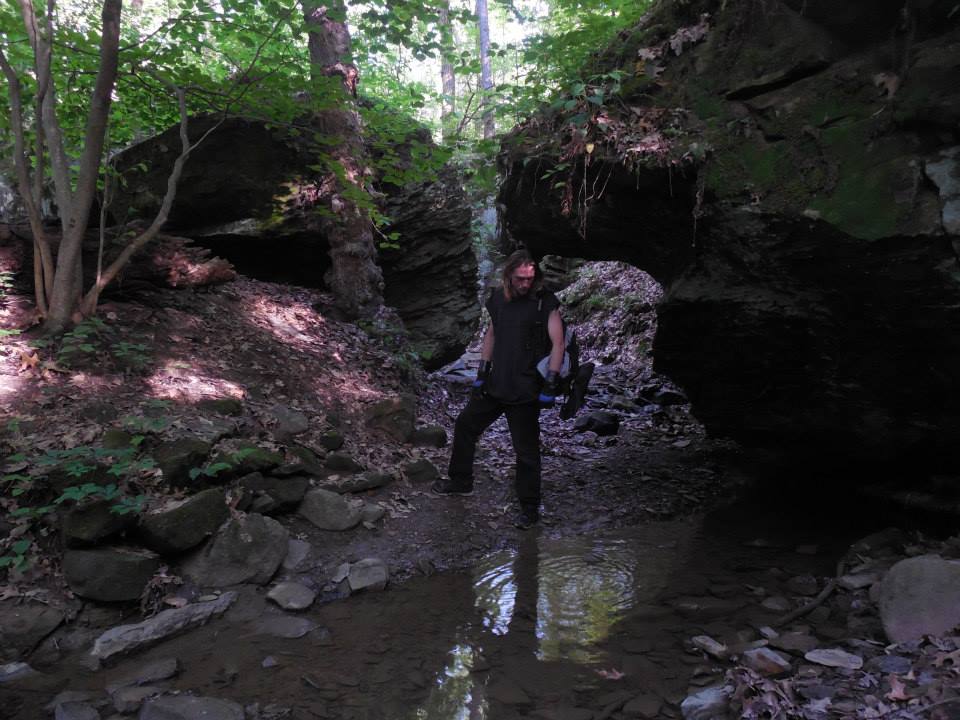
The first leg of the quest took me through a far more ancient landscape than the island itself. A dark forest of rocky ledges, a shallow streams, caves, and waterfalls.

This was the difficult part of the overall quest. I got lost twice and had to backtrack several miles in order to correct the mistake. The rugged terrain made the correction alone take nearly two hours. With the sun in the western half of the sky before I even reached the forest, things were even darker than they might have been mid-day.

While the dark forest was enchanting in its ancient feel that landscape was difficult to capture on film. Twice the camera fell during filming and while the camera itself didn't suffer any damage the tripod did after tumbling off of one of the slopes when a loose rock fell, hitting one of the tripod legs.

There is a cave in this same forest that I wasn't able to get into because the recent rains I mentioned had flooded the valley that cuts through the heart of the forest where the cave lies. By the time I got into the area the cave had already been flooded.

But... I was able to navigate through the ancient forested landscape and make it safely back into the light, even if the gear did take a beating in the process.

I came out of the dark forest with some of the most stunning images of the season to date and a twisted knee - an injury suffered while making the jump to the lower valley floor. The injury just happened to be captured in the video. You can hear the impact, the instant sting, and see me stumble when I hit the ground.


Island of the Gods - Part One (VIDEO)


This photo (above) is of a shrub that grows on the Island of the Gods itself which I was able to reach after a tenuous river crossing that I took inch by inch - having to keep my body turned sideways against the strong current. If I had tried to face it directly the river current would have swept me downstream. To date, I have not been able to identify these shrubs that grow in the Island of the Gods and no where else in the entire river valley. In all of my travels this is the one and only place I have ever seen them.

The island was pretty much as I remembered it. Here everything seems to be 4 times the average size from the stones themselves that make up the island to the various types of shells and sea glass that liters it. Even these mysterious shrubs grow to incredible heights and girths - somehow able to withstand the frequent flash floods of the temperamental river.

I really had no idea what motivated me to go back to the island aside from some of the most memorable stories in this series coming from it. I simply woke up one day knowing that I had to go back.

Once I made it to the island I set up a spot for my gear and began searching the island in a grid like pattern, looking for whatever it was I was suppose to find with no idea what that something was. Of course I found peculiar stones, large shells, huge chunks of sea glass, a wealth of goose feathers strewn about, and all of the other standards. The island happens to be huge in comparison to most others along the river with a swollen center where the shrubs grow.


It was amid these shrubs near the highest part of the island where I discovered this (above) wedged deep into the sandy crust. A discovery that was captured in the film because I just happened to be recording video of the island when I came across it. The piece is hallow, almost as a spear head but far heavier than one would expect a spear head to be. Still, that was the first thing that came to mind when I discovered it.

I've been working with the piece for weeks now in order to forge what will be called The Spear of Keravnos. 

The piece currently rest inside Hera's Altar Room.

Island of the Gods - Part Two (VIDEO) 

The Chain of Fate

Discovering the valley where the Chain of Fate was hidden posed a few challenges due to some of the locations along the way not being on any map. Which I thought odd considering just how many detailed maps are available. The journey was also a race against time. Much of it was done just before sunset and it was well after dark before I made it back to "civilization".

The adventure took me further south that I had anticipated, hooked to the west into a deep river valley where that falls were tucked away under the arches (Right).

And there near the falls, as foretold, was the natural cavity cut into the rock itself by thousands of years of swirling water when the river flooded where I found the golden chain.

It was a moderate climb down the rocky river bank in order to get to the falls themselves. Many others who take on the venture reported it to be a difficult climb down and even harder getting back out.

From the overlook area the rocky slopes look intimidating enough. Most of them are sheer drop-offs of smooth rock face. No footholds, nothing to hand onto. But just to the south of the overlook, hidden in the brush, is a trail snaking down most of the way. A little jump at the bottom and one finds themselves face to face with the cascading falls.


Once I retrieved the Chain of Fate I had to make my way north along the river bank until I came to a narrow passageway where the bedrock had actually split in two. From above this same passageway cannot be seen. The ground appears to be solid. An illusion brought on by the angle and the fact that both chunks of earth have a matching pattern to them. You have to be directly over top of the chasm in order to know it's there. And that chasm is the only way back out without climbing gear. But even using the chasm led me to a secondary rock face I had to climb in order to reach the trail heading out. Luckily the secondary face was broken and covered by thick tree roots that gave me the ability to climb.

The Chain of Fate now rests in the altar room at Hera's feet. Another ritualized test completed bringing me one step closer to my goal.

But passing these tests and attaining the power of lightning are two very different things. From here on the journeys will be much more difficult and far longer. Tests of strength, endurance, and resolve are coming from the landscapes alone. Not to mention what the Gods themselves might throw onto the path.

What is to come next might very well provoke Zeus enough to take notice once again as I prepare to return to the island where I discovered the Seven Mile Altar Stone and the fulgurite Eagle. The next leg of the journey will take me back to the Island of the Gods. The same island where Zeus manifested so prominently during the final quest last year. And unlike all of the other quests I have taken on this season, I have no idea what lies in store or what it is I am to discover on that island.

The Long Road


In just a few short hours I will be heading off on a road trip that will take me all the way back to the very fountain, setting in the center of the gardens it took me nearly 4 years to build, where this very story began. It was there, in that same garden where I woke up one morning to find a single peacock feather unexplainably lying in that lion head fountain. The same feather that crowns the entry way into my altar room, looking down on me as I write these very words.

Hard to imagine such a tiny thing having the ability to begin such an epic journey. If that feather had never appeared my tale would have never taken the direction it did. I might not be so connected to Hera, this blog might not exist for the world to see, and so many countless adventures might never have been had.

From that feather came all of it. This written account, The Journeybook videos that chronicle my journey beyond the written word, the digital art, stone carvings, grande altar room, my defiance against Zeus. It has permeated nearly every aspect of my existence from the mundane to the unbelievable. The later being the motivation for the video series. Having it captured on video and thousands of photos does tend to lend to credibility. In this age people like to watch adventure such as this more than simply reading about them. They want to see it. And thus far I have done pretty well at giving them that opportunity.

My path was of course raging on long before this all came to pass. It took me the better part of 20 years to become what I am today and be chosen for this journey. Prior to discovering the feather and finding myself on this quest I had little to do with the old Gods, didn't really care for any of them. I was raised in a rustic countryside environment, came out of the forest to become a well known warrior in the world wide pagan community. From warrior I rose to become a pagan king. Challenged by over 20 men over the years for my crown and title and to this day that crown and title remain undefeated. As king I created one of the most powerful, impactful, revolutionary, and nearly undefinable pagan dynamics to ever exist. Unlike the modern re-constructionist who tend to the lambs I only tended to the lions.
Thousands of them came and over the years thousands of them fell. In spite of everything they believed to be true about themselves they simply could not endure. Until finally, there was no one left and I sat there on that throne all but alone. The great hall I ruled over and all of its people had fallen. Yet, I remain.

I'm not always sure what it is that drives me on beyond the limits of all others. Perhaps it is fearing the shame that might come in leaving such a tale abandoned and unfinished. Perhaps it has nothing to do with me at all. It may not be my will pushing me forward down a path I can scarcely see nor hardly believe myself.

This morning, as I set here before the Altar of Hera, preparing for the long journey back to where this all started I can vividly see the path behind me. I can see every loss, feel every pain and the kind of exhaustion that only comes from traveling a path too far, for too long, and knowing that you are still no where near the end of it - you never will be. The beginning and the end no longer matter. There is only the climb.

If I succeed in what is to come just this year I will have bested Zeus himself, won the heart of Hera, will sip honeyed wine made from a thousand thunderstorms, and hold the power of lightning in the palm of my hand. All for the world to see in word, video, and photographic glory every single step of the way.

And then what?

You see? It's not the Gods that put the questions in my mind.
It's eternity.

The Hammer of Hephaestus


"Hard to fight the Olympian strength for strength."
Hephaestus, The Rage of Achilles, p.IXV II 


And so it was that the journey continued onward, heading first north through the valley of forges. Many of which have long since been abandoned and left to ruin. A rocky, reeking, poisoned, narrow stretch of land, stained in the blood of iron itself, going on for miles. Hard to travel, harder still to capture.

It was in this vile valley where there lay an island of ivy beneath a high bridge, just to the east of the river. Into the ivy a concrete stairway with crescent moon landings and there at the top, silver and shining with a gleaming black handle lay the Hammer of Hephaestus which in its hard kindness brought brilliant color to the landscape.

Why north when the ultimate goal lay far to the south? Far down the river valley, beyond that great waterfalls where the Sisters of Fate dwell, far beyond the climb and deep into the forested ancient sea bed where the earth itself was ripped apart in some ancient battle with the elements and never ending pull from the heart of the earth. Why north? Why this wretched valley of iron and waste to claim a forgotten hammer of the lame God? 

"Hard to match the Olympian strength for strength." Hephaestus said. It would take more, much more and as the journey continued Zeus himself made it a point to have his attentions felt. Conjuring up day after day of thunderstorms and hard rains. But he had manifested the tempests too late, his move was seen before he had made it. 

North, beyond the iron valley of the forges, lay a long stretch of blessed green where garden after garden, full of fountains, flowers of every kind, and ancient trees represent the great nations of the world and the many cultures that came to tame this land. It is in the stretch of life where rests a garden crafted by Greece itself. 

Two Doric columns frame the garden's entrance, opening into a plaza containing a reflecting pool, offering a perspective on a wall and pylons, which symbolize the wall of the Parthenon. Stone tablets on that wall and pylons are inscribed with the names of prominent Greek artists, philosophers, writers, and scientists: Solon, Ictinus, Callicrates, Phidias, Aristophanes, Pericles, Euripides, Sophocles, Aeschylus, Homer, Praxiteles, Zeuxis, Apelles, Myron, Lysippus, Scopas, Sappho, Socrates, Anaxagoras, Aristotle, Plato, Aristarchus, Demosthenes, Pindar, Archimedes, Herodotus, Xenophon, Thucydides, Euclid, Hippocrates, Ptolemy, Pythagoras, Polycletus, and El Greco.

Framing the symbolic wall are two paths that encircle it, leading to sandstone terraces, lavishly planted with ilex, coloneastus, myrtle, and sweetbay, with cedars and Lombardy poplars giving the impression of cypresses. 

The Hammer of Hephaestus is to be taken there. It's strength combined with the sacred waters of the fountain and a three measures of the blessed waters taken. The first measure it to be brought back to the Altar of Hera as a votive offering. The second measure is to be used in an ritual anointing - to make the flesh strong, the will - hard as iron, and award strength as fierce as the Hammer of Hephaestus itself. The final measure is to be placed in the altar room until the final journey is to be undertaken. Cool, healing waters imbued with immeasurable blessings to aid in the quest.

The journey is taking us counterclockwise around the 60 mile radius of the stone votives circle cast last year. Symbolic of traveling back in time, relearning, gathering strength, increasing endurance, making amends for the past defeat. A test of the will, a test of the heart. Long, hard, exhausting. But not so much as the long path that lay behind - the year after year of this singular theme that began with something as delicate as a feather. 

A long way left to travel with every step in defiance of Zeus, weakening his ancient bond on Hera. Zeus takes note, sends forth his storms, thunder, and lightning. And with the coming of the torrents a crystal bowl, taken from the Altar of Hera is placed in the rain. A single measure for each storm cast - taken and placed bowl by bowl, storm by storm, into a sacred vase. Once full the waters taken from Zeus's storms will be combine with the waters taken from the garden fountain, transformed, turned into golden honey wine - lightning and thunder in a bottle. Seal with blood red hard wax and presented to Hera. 

The journey, the sacrifices, the votives, the recounting of the tale for the eyes of the world to witness old Gods on new streets - Hera grows stronger with each tribute and Zeus weaker with each step of defiance. His conjurings and manifestations shrugged off, claimed, bent and twisted to advantage. Cunning, peerless, unheard of in the modern age. 

A fitting end.


Rise From The Ashes


When Zeus took it upon himself to interfere with the quest to break the bonds of Hera the world watched as the quest ended in defeat at the very foot of the forested hill where the final Heraian Votive was to be placed. But in spite of the astonishing manifestations and actions of the King of the Gods this would not be the end of the journey to release the Goddess from her ancient binding.

On March 30, 2013 the quest began anew and The Journeybook chronicled the rise from the dirt and ashes of defeat, great sacrifice, and a climb out of the river valley where the new story was to find its beginning.

The bridge in time between the defeat and the rise landed me on the very river bank where the bronze statue of Hera is taken on the Spring Equinox every year to be washed in the waters of the river.

Defeated, covered in dirt and rubble, it was necessary to offer up sacrifices in the form of ash and flame.


Sacrifices to the Gods must be something of rarity and value. It is the very definition of the word 'sacrifice' - to give up something of worth. As an offering to Hera in light of the defeat the altar ash, collected from the votive burnings in the Altar Room over a three year period were given up. Mixed with the dirt and rubble in the opening sequence of The Ashes of Prometheus Video. At the same moment, off in the forest, an iconic blue rose waited alone in a landscape that had been laid to waste by a massive flood. The tress splintered and strewn about, the land covered in a think layer of sediment and sand. The blue rose was the only color in this dusty and drab landscape.

Like a phoenix, as I rose from the earth the blue rose began to burn. A life for a life. The great symbol, reaching far into the past, was taken by flame so that a new flame could be lit from its sacrifice.

As the flames consumed the blue rose, unleashing its memory and power, the renewed quest to finish the long, complex ritual to free Hera and defeat Zeus began. And what would rise from the ashes of sacrifice was something new to this story. Something that Zeus himself knows all too well...

 ... the power of vengeance.

King vs King


 The Journeybook is the ongoing interactive project that not only records many of the events written about in this very chronicle but also brings others into the story as both witnesses and philosophical debaters. There is a vast number of people out there who make and swear to  lot of things. But when it comes to offering up visual proofs, when it comes to walking their talk, they come up short.

My relationship with Hera which led to the creation of The Heraian and The Journeybook Network on YouTube where this story plays out in front of the world  is both simple and radical.  Surely it is an unbelievable story to many, until they see it playing out in the near 100 videos already included in The Journeybook. The first season of which, chronicled the adventure of placing 22 hand carved stone votives to the Goddess Hera in various locations as part of a lengthy ritual that defied Zeus. A defiance that did not go unnoticed or unanswered for. I did, in point of fact, fail in the quest to place the final votive and complete the ritual in the final chapter of the season. A failure which was also well documented here. I have no shame in this. It happened, it was recorded, an none of us involved in this story are entirely invincible.

My story is an anomaly in the modern Age. Paganism in general is on the rise the world over in countless different flavors and interpretations. But no one else has dared take on a path such as this one and even within classical Greek myth those who aligned themselves with Hera and defied Zeus in one way or another did not end up with a "happy ever after". In fact, some of the most sadistic punishments ever conceived came from the mind of an offended Zeus. I know those cautionary tales well. I simply don't care.

As the events of last year played out, as votive after votive to Hera was placed, and I came closer and closer to pulling off the ritual my own realm and people were all but annihilated. Once the most powerful, feared, and revolutionary force in the global pagan community has fallen to ruin where only a precious few struggle to hang on. While I was out questing for the glory of Hera my world and all that I had suffered for and loved fell to apathy and betrayal. By the time the final votive was to be placed my people were expecting a victory and instead they saw me fall just 3 miles short of the end after suffering an abdominal injury and enduring freezing temperatures in the middle of a forest with no shelter.

Following the defeat I was insatiably angry and full of rage. I had been defeated after traveling over 1,000 miles in my quest, my world and people lay in ruin, and at the center of it all stood Zeus - the God who I had defied at the side of his reluctant Queen.

It was to Hera which I turned following the assault and from Hera which new power came forth. Holding to the idea that all not only had to be written but shown this new strength was also filmed and displayed before the eyes of the world, quickly becoming one of the most viewed and awe inspiring videos in the entire story.


For the past 5 months I have been in training to hone my strengths and abilities in order to continue on with my quest and this very story. As of this writing we are only 2 days away (March 30th) from the first quest of the Second Season of The Journeybook where this story will continue to unfold before the eyes of the world in a new series of videos and thousands of new photos along with the written account that is this very blog.

Not only will The Journeybook reveal stunning landscapes as we quest to place the final votive and rob Zeus of his power - breaking his bond over Hera - but it will display and illustrate abilities that come only from this level of devotion to a singular Goddess. I will not only write and talk about it, I will show you and I will do it all LIVE.

I could, like many others, have these experiences and keep them to myself. Never offering such proofs of what I claim and write of. But what would be the point in having them if they are not shared experiences? However unbelievable it is a story that should be and needs to be told. You do have to see it in order to believe it. 

I am a pagan who came from nothing, rose up to become a King, created a spiritual pagan dynamic and realm that is unmatched and peerless, gained the favor and love from an individual Goddess who I have honored and glorified with unprecedented passion and devotion, and defied the will of Zeus to the point that I have made a clear and welcomed enemy of him.

Zeus represents everything I have come to hate about the world of men and the petty nature of the Gods. His affronts to Hera and misogyny will be answered for and it will be me who passes down the punishment in Hera's name.

Anyone who watches The Journeybook beyond the written accounts of this blog will witness a battle between a Pagan King and the King of the Gods. And we will battle it out until only one of us remains.

I have already publicly announced that I am putting my title as the King of the Denians on the line in the Second Season of The Journeybook. If Zeus answers my challenge and manifests to face off with me again he will either end my 17 year reign (and this very story) or the world will bear witness to me setting before them with Zeus's power in my own hands.

Defied, robbed of his power, his bond over Hera broken, Zeus himself - the ancient King of the Gods - will lay defeated at the hands of a mortal who fought, suffered, and sacrificed to become something else. But it is not the power of Zeus that is to be my prize for victory. This is not a quest or battle for power. It is a battle for the hand and heart of Hera herself.

To win the hand of Hera Zeus himself must be defeated. And the battle between mortal and God to see that happen is about to unfold before the eyes all all.

The 22 Votives of Hera

(NOTE: The 22 Chapter adventure chronicling the placement of the 22 Hera Votives in both picture and videos can be viewed HERE)


Hidden within the proverbial pages of The Journeybook Adventures is a somewhat hidden secret that has only been mentioned in one of the chapters thus far.
Among the items taken on each adventure is a single hand carved stone votive (22 votives in all). With each adventure one votive is left behind, hidden somewhere in the landscape at the far edge of the journey.

Each of the stone votives are unique and each depicts the Goddess Hera, one or more of her personal icons, and (always) her name.

This semi-secret mission hidden within each chapter of the ongoing adventure makes each of the stories into an untold evolutionary ritual that includes multifaceted levels of sacrifice and hardship ending with this simple tribute to a very specific Goddess. The ongoing ritual is a proving of worth and devotion for yet another hidden purpose.

Included with the 22 votives of each chapter and trial are many other creations and stories. Such as the trial of the 7 mile altar stone, the rebuilding of the altar room, the procession to the river for a ritualized bathing of the Altar Statue, the writings, videos, and other tributes, the scholarly studies, meditations, and more. All smaller pieces of a much larger story that now spans years.

It is a hard path of many body bending, soul torchering challenges that breaks many boundaries and preconceived limits. It is the art of sacrifice and tribute, the path of devotion with many pains, the practice of going beyond all reason and doubt.


22 stone votives, 22 chapters in story of passing the tests and placing them.

When the 22 trails, adventures, and tributes are completed they hidden stones will form a pattern over the map of the land that extends over 30 miles in every direction with the altar room and my home at the center of it all. Here, where the largest of all stone votives to Hera within this story is held - the 7 mile altar stone itself.

The Journeybook has been a wonderful experience for me and I hope that it has come to be the enjoyment of the many who subscribe and watch the story unfold. This is simply a glimpse of the story within the story. The somewhat hidden, the somewhat mysterious, the absolutely pagan.

Angel Snowden and the Altar of Hera


The Seven Mile Altar Stone (July 2, 2012)

Today I decided it would be a good enough day to go out hunting for more crystals in the river. Plotted out a course over a 10 mile stretch and set out for the hunt. I hit every island and beach I aimed for except the tow closest to home.

The reason for missing the last 2 islands: On the return journey I was already lugging over 70lbs of weight in 4 different bags. The bulk of which was from a single stone that took up all of the space in my back pack.

I retrieved the stone from an extremely bulky island that all but completely blocks the river, splitting it into two fast running streams on both side of the island. The island itself is a hill that is made from sand, gravel, and large water polished rocks of all sorts; only a few of which was of much worth to me.
Then there was this one stone. Heavy, flat, and perfectly polished. I wrestled with the notion of hulling it back knowing how impossible the task was going to be. I didn't even know for sure if the thing was going to fit in my backpack.
I dumped everything I had collected into my spare bag and tried to divide all the weight up as much as I could. Stuff this huge stone into my backpack not knowing if the weight was going to break the straps, or worse, my spine.
Once I got the weight situated I made my way to a shallow area of the river and walked across the water to the steep bank where I had to remove the bag, toss them up, and climb out before retrieving them and setting up again.

After that, it was a very long slow mile journey back home that included a climb up the western valley wall - a steep incline of over 200ft.

But the time I reach the top of the valley I was all but ready to call for help. it felt like my heart was about to fly out of my chest and I was getting tunnel vision. I sat down for a few moments and tried to calm myself down but I was overheating badly.

So, I forced myself to make it another block to a tiny little store that sets there near the top of the hill where I got a cold drink and took a few moments before weaving my way through the last few blocks home.

The things I found today are all huge in comparison to what I have gathered out there thus far. Including three pieces of anthropogenic glass bigger than my hand and in all of this...only one new crystal like the others I found.
I'll be taking some pictures of the new pieces once I get them cleaned up. At the moment I am still trying to recover from going just a little too far across the line today.

I almost have everything I need for a rebuilding of the altar room.
Almost.

Carving the Altar Stone (July 3, 2012)

In spite of the trials of the day I've stayed up to carve out the Altar Stone I collected from the river island earlier today. I may go back and add some finer detail but it is 1:15am now and I have already gone through 3 diamond tipped bits carving this stone.
The stone measures 16 inches wide and 5 3/4 inches tall.
I carved Hera's name on the raised back portion of the stone and encircled it with a basic vine pattern. Then, etched my name into the back of the stone. (Always sign your work. Otherwise, you won’t get credit 5,000 years from now when some archeologist digs it up.)
Tomorrow I will carve a votive prayer onto the bottom of the stone (which I will not be sharing).
This stone is to be used as the base for the altar statue which will rest on a 3ft high altar table at the center of the room aligned with the double glass doors leading into the living room.
The stone will be the first item placed into the newly designed altar room and then the rest built up around the stone. The statue itself will be the last item to be put into place.
The Goddess needs a temple before she can walk into it.

The Day of Storms (July 3, 2012)

At this very moment the altar room is nearly empty and almost ready for its detailed cleaning and scented water/oils wash down. And the wonderfully odd detail of the day: at the same time I began removing the items from the altar room a massive thunderstorm rolled in and it has been thundering loudly enough to shake the house ever since.
And me, I have the windows all wide open, harvesting the wind and rain, washing out the entire house with the power of the storm. Opened it all up and let it right in.
And the thunder rolls.
Think Zeus might be a little pissed that I stole his wife?

Let's piss Zeus off by using the rain water from the storm to wipe down the altar room instead of tap water.
Little rain, little essential oils, little stormy wind, and we have ourselves a nice clean room to start in.

Base Cleaning and Cleansing (July 3, 2012)

Now that every item has been removed from the altar room I get to the initial cleaning and cleansing part. As I mentioned in a previous post I gathered rain water to wash the room down in. To the rain water I added Spring Meadow, Apple Cinnamon, and Cinnamon Nutmeg oils to give the rain water a very natural and earthy scent.
Now, before washing anything with the scented water I used a portion of it to fill an spray bottle. This portion will be used to scent the carpeting, table cloths, the cushion of my moon chair, and the pillows.
I wanted to make sure to detail the base boards of the room because a lot of detail will be put into that area of the floor. All of the walls, woodwork, and the ceiling have all been cleaned with the scented rain water. (People almost always forget to clean their ceilings - the one place that collected more humid air than any other spot in a room, making it a breeding grounds for all sorts of nasty things.
After the detailed wipe down I cleaned all 10 windows that surround the room and the glass doors leading out. Then, I cleaned the carpet and sprayed it down with the bottle of scented rain water. I followed that up by opening all the windows up to flush the room with fresh, after a thunderstorm, air.
After the carpeting dried I then traced the entire room in salt. (The first boundary.)
And now the room is ready for the placement of the 3ft high altar table and the new altar stone I carved last night.
Once I have that set up I will head off to the kitchen where I will be washing every single item that will be going back into the room.

Setting the Stone and Votive Displays (July 4, 2012)

Now that the altar room has been prepped comes the placement of the altar table. The table itself is set into the center of the room. A focal point from both the outside as well as the inside. From the outside the altar can be viewed by passersby when the blinds are open to allow in sun/moonlight. Normally I leave the blinds open until I retire to bed unless the room becomes to hot in the afternoon. In which case, I shut the blinds and open the window so that Charlotte (my 11 year old tarantula) doesn't die from the heat.
Before the cloths and stone can be placed on the altar table it gets its own cleaning and a wipe down with pure essential oils. The oils will soak into the wood and their essence will be absorbed into the altar cloths.
I've used the same altar cloth now for a few years. This time however, I added a second cloth to cover the entire surface area of the altar table. The extra white cloth reflects a good deal of sunlight making the altar top appear to glow in the afternoon.
Once the altar stone is set and centered the backdrop can be built. When setting up an altar I have always held to the general notion of: Black on the left, White on the right. This offers a sense of realistic balance with the Goddess at the center of all that is good and bad. The backdrop begins with two floral arrangements. One light, one dark, both accented with peacock feathers and pomegranates with long thin extensions that nearly reach the ceiling and gold encrusted pear limbs.
Hera, contrary to popular uneducated bullshit, began her life as a Nature/River Goddess with the Spring Equinox being her birthday. Hence, the floral, earthy oils and arrangements. Pear wood was common in the temples as a material used to make her votives and there is a long standing connection between Hera and the Pomegranate - fruit said to be of the Underworld. Heroes would drink pomegranate juice before going into battle thinking it gave them a measure of immortality. And the gods fear the nectar thinking that it temporarily robs them of theirs. Some purpose that Hera used the potion on Zeus to weaken him before she set him in chains and began the Gods revolt against him.
Peacocks and lions are the "Um duahs" of a Heraian Altar, both being sacred to her. The peacock feather is important because it is a window of sorts. Anything within the view of the peacock feather's "eye" is known to Hera. And so the altar backdrop extends with a peacock on the left and a lion on the right. The lion standing upon a wooden case that holds a mummified rose wrapped in a peacock feather and covered in a bed of crushed lavender, lilac and sage.
Below the ever watchful lion, a crystal collection. Including the crystals gathered from the same river where the altar stone itself came from.
Above it all, "The Eye of Hera" (see archive) is suspended above the Greek styled altar light that sets in the center of the backdrop and is never turned off. The back-light is there to primarily illuminate the altar statue as well as keeping the room from being cast into darkness. The altar room is NEVER dark. Not even while we are sleeping. The light is to remain at all times. If the power goes out the room is then lit with special candles until the power returns.
Holding with the light/dark aspect of the left and right side of the altar - dark stones and votives are placed on the right side of the altar extending all the way to the corner with lighter stones and votives on the right (light) side.
The right/front corner of the room displays a Greek column with Pan and a fairy surrounded by river stones, incense, and feathers in an earth and air theme.
The left front corner of the altar room is decorated with my grandfather's cedar trunk holding frosted white, aqua, and blue anthropogenic glass, "Hera's Pearls" (milky white rounded quartz stones) and vials of herbs and oils. Accented with white candles and a photo backdrop. In this same corner I place "Hera's Scepter" - made of pear wood that was soaked in red wine for over a week to stain the wood and then crowned with a glossy red pomegranate. Near the top of the scepter Hera's name is carved into the wood.
The right front corner displays copper and 14k gold items that were handmade and imported from Greece and a Greek calendar.
The left front corner of the room is dominated by the spider tank that is laid out with a Greek vase, green glass, a golden clock face necklace, a green scrying glass, mirrors, and is crowned with an import piece of artwork known as "The Wings of Icarus". This display is still in the works and will hold to a Sisters of Fate theme.
Tonight I crafted two glass vases. One contains a large shell from the river surrounded by anthropogenic glass and a red ribbon. The other is of a peacock feather eye suspended in anthropogenic glass of various colors to accent the colors of the feather.
And now it grows dark. So, the altar room will be lit and shut up for the full moon night and we will finish setting the room up tomorrow. After everything is in its place the room can be sealed up and the cleansing, charging, and blessing of the new altar room can take place to prepare for the placement of the altar statue itself.

The Day of Fates (July 4, 2012)

The Sisters of Fate have been figures semi-hidden in my personal mythos for a very long time. Because I take so many different types of risk and so many of my life's tales have bordered on the irrational and unlikely outcome is the common manifestation the Sisters are always there for the logical conclusion of influence. However unlikely that conclusion may really be.
Within my relics collection is a large green glass scrying orb called "The Sphere of Time". In the past it was common for me to use this orb in meditation to follow threads of time down the most likely course of events. Having that ability did not go unnoticed however. Not even here where it has often been illustrated that I know how events and threads will unfold months before they actually take place. Even today I can offer insights, to those who ask, of what is likely to take place 6 months from now. How certain people will react to those events and be the one who manifests the very thing I spoke of, even if they try with all their will not to.
The essence of Time has always been something that lent a powerful energy to the current of Denian Tale. How things develop, who will (against the odds) come into the story, what will be treasured and what will be lost forever. The ability to see these threads borders on a type of scientific method. There is a specific way to do it and if not done correctly the prediction will simply prove wrong, every time.
Such oracle practices are all too common in the world, even today well beyond the pagan realms. The difference between now and the ancient world is that the people who practice these arts are rarely ever referred to as "Oracles" but instead as "Readers".
They use tarot, runes, meditations, and even mind altering drugs to do it. I use "The Sphere of Time".
For more than a decade now that very sphere has been kept inside a glass tank and treasured by a rose haired tarantula who is now the size of my open hand with 1/2 inch curved fangs, the ability to flick stinging hairs into your skin, and spin enough silk to cover everything inside her glass realm with silver silk in one spinning.
She prizes the Sphere of Time and has a habit of running to it after her tank is cleaned or if she hears a loud noise. The sphere has long been her one constant. The one thing that has always been there. She knows it and in that knowing she is comforted. She also attempts to spin her web over and around the orb in what I think is an attempt to keep it in its place.
In keeping with Time that tank also holds a clock-face medallion encrusted with crystals, laying on a small mirror. A piece that I have never worn before. It was gifted to me and has been inside the tank ever since. Now completely wrapped in spider silk and half buried in the sand.
Shards of green glass, the green orb, the clock-face medallion, my Golden Compass (used in The Journeybook Adventures) and a small green vase depicting the Sisters of Fate, this is the setting for the focal point of the front left corner of the altar room.
Above the tank "The Wings of Icarus" displayed as a constant reminder and warning of going too far, too fast.
Below the tank, items collected on my adventures. Many of them to be gifted, traded, and bartered away. Changing the course for others along the way. All symbols of intertwined Fate, physical manifestations there as proof that other lives and destinies are all part of the same story.
And below that still, the journals. hand written accounts of events as they unfold. The untold, unseen details of the Denian Myth. The greatest events in the entire tale included with dates and times that they happened. The unpublished record of everything done here past, present and future.
This is the work of the day. The final wall of the altar room. once finished and presentable I will go back over every display and altar the tiniest of details in them all. Stones to be turned a certain way to highlight their color, crystals turned to the sun to glimmer at different times of day. The lighting all set and balanced.
When the details are done and the room is set to standard it will be time to go up a bit higher.
Above the door leading into the altar room is a acroterion - A kind of crown that marks it from beyond the room as "sacred space". The acroterion for the altar room is an ornamental disk displaying my Heraian Shield Symbol with Hera's name inscribed on it. The acroterion is crowned by a peacock eye and is flanked with dry flowers leaning into the acroterion and two more peacock feathers leaning outward. Both sides of the doorway are flanked by free hanging ivy vines and a large vase of purple flowers sets in front of the right side doorway, which is normally always shut.
It is to all be cleaned, cleansed, and redesigned; which will require bringing out a ladder because our ceilings are just over 16ft high in the living room. (Add another 2 inches or so for the decorative molding)
Only after the acroterion is refinished can the room be prepped for another round of cleansing, smudging, and detailing. Once that clears, candles, oils, incense, and sage will be burned and the altar stone blessed. It normally takes about 3 hours to fully charge the room with elemental energies.
After which it will be sealed for a certain period of time. No one in, no one out as to altar room is allowed to balance itself out.
Once the balance is achieved we can then move on to cleansing, blessing, and placement of the Altar Statue.

Second Charging and Blessing (July 7, 2012)

After the detailing if the display in the altar room is completed comes the long process of blessing and enchanting the space - a ritual that takes days to complete. The reason it takes time is because it is done in layers of sort with each element having its own time and place in the room and multiple cleansing of the space done in various ways.
All ten windows are traced in a potion of oils and salt water with herbs and other things placed between the panes of glass. The carpet is treated again with oil scented rain water, sprinkled with salt, and quartz crystal dust. The walls and ceiling are treated with another washing of rain water, and and all 40 of the windows that make up the folding door entry way are also traced with pure essential oils both inside and outside the room.
The room is then allowed to rest and balance over night with the windows open to the night air.
The next day the altar stone is washed and detailed and candles are placed on both sides. Oil burners are filled but not lit. Incense and sage are lit throughout the day and into the twilight hour. At twilight the oil burners, candles, incense, and sage are all lit in unison and the room sealed up. It is to remain sealed until the candles in the oil burners and incense go out on their own. The sage will always go out more quickly. The candles lit on each side of the altar stone will remain lit throughout the process, being they larger candles.
The room remains sealed and filled with the scents and sage smoke, and flame to cleansing every item in the room.
Once the room has settled it can once again be opened to the night air and allowed to rest.
This process can be repeated for days until the space inside the altar room has a specific charge to it. The room is nearly set for the placement of the altar statue. But before the statue can be placed inside on the altar stone we must tend to the acroterion above the entry way and plan a morning procession to the river.
We will get to the acroterion, its history, design, appearances, and meaning in the next piece. Once we have the acroterion redesigned there will be one last blessing of the altar room where the double doors leading in will be left open for the process to merge the sacred space inside with the energies in the area just beyond the doors. I will tell you the reason why that is necessary when we discuss the acroterion.

The Acroterion (July 8, 2012)
The altar room in effect is now consistent with a type of cella. In Ancient Greek temples the cella is a room containing a statue representing the particular deity venerated in the temple. One major difference here is that the altar room is surrounded by windows, connecting it with the outside. A common temple cella had no windows. Here, the entire house and property might be considered the whole of the Temple. In addition the cella may contain a table or plinth for votives such as votive statues, precious and semi-precious stones, helmets, spears, arrow heads, swords and war trophies. The accumulated offerings made Greek temples virtual treasuries, and many of them were used as treasuries in the ancient world. And this we have achieved in detail within the altar room's design.
Now, we move beyond the altar room itself to take a look at the Acroterion.
One of the greatest muses in my Heraian Path comes from an ancient fragment that reads:

"With combed locks they would frequent the precinct of Hera, swathed in beautiful robes, their snow-white tunics sweeping the floor of wide earth. Golden cicada-like brooches surrounded their hair; their flowing tresses bound by golden bands, floated in the breeze, and intricately decorated bracelets encircled their arms...a shield-covered warrior." (Asois)

The last part of which has held my intrigue for some time because the line doesn't seem to fit with the rest of the recounting of temple wonder and the beauty of the priestesses. It is interesting to note that this Bronze Age description of the priestesses at the Temple of Hera is still reflected today with the dress of the priestesses who ceremoniously light the Olympic Torch as the Temple of Hera at Olympia, officially opening the Olympic Games.

This same fragment is what mused the design for my personal crest that is also the center piece for the Acroterion, along with the original peacock feather that was found in the central fountain in the Gardens of Lisocea that set me on my current path. The story of the discovery of the feather can be read at The Temple of Hera at DENIA.

Now, an Acroterion is just a fancy word for a decorative center piece that is placed at the apex or highest point of a Greek Temple in Classical design. Often these were based on a floral design but many different patterns and notions have come up in architecture around the world with the same principle in mind. The notion dates all the way back beyond 420 BC.

I took the classical note of floral design and blended it with the Asois fragment "a shield-covered warrior" to design my personal crest that is the crown of the altar room's Acroterion. I bordered the shield with peacock feathers, lily stems, threads of pine tipped with pearls, and dried flowers. Then, topped the shield with the original peacock feather. Handing down from the entryway one both sides of the Acroterion are free hanging ivy vines.

The entry way to the altar room is 10ft high from the crest of the Acroterion to the floor, the double glass folding doors take up 7ft of that space. When fully open the entry way into the altar room is 6 1/2ft x 7 ft leading into the living room where the altar statue and displays can be viewed while lounging around with the Acroterion there blending the two rooms, marking the altar room as sacred space, and on a more metaphysical note, project the energies of the altar room outward as I reflected in my new design with the peacock/floral pattern lending outward in a "bursting" pattern.

Inside the altar room, the altar itself also reflects this outward energy in its design with the angles of the edge displays and votives matched with the angles of the outward flowing Acroterion above the door. The combination of the two outward flowing designs offers a kind of "open arms" feeling to the entire scene, drawing one's eye to the altar itself as a focal point, and creating a welcoming feel. Follow all of the lines of both the Acroterion and the angles of the altar room displays and they all lead right to where the altar statue will set.
In the next piece we will be headed outside where tonight I am tending to another part of the altar room (that is also part of the over-all layout on the inside) and discover why it is important that the altar room be surrounded on the outside of the house by a flower garden - peacocks and all.

The Gardens (July 8, 2012)

Hera, long before she was raped by Zeus and married him to hide her shame, long before she was seen as the patron goddess of subservient wives and marriage, long before Zeus ever even came into prominent status in Greek society, was a Nature Goddess who's birth was on the Spring Equinox, tended to her own orchards where she grew the Golden Apples (a gift from Gaia, one of the Titans), as a River Goddess in respects to her place of birth on the bank of the Imbrasos River, as a prophetic Goddess who was able to influence the destinies of mortals as well as imbue them with great power as she saw fit, and as the Queen of the Sky and Starry Heavens.
Hera is a purely Greek divinity, and one of the few who, according to Herodotus, were not introduced into Greece from Egypt and antithetical to popular notion and incompetent would-be scholars should never be confused with, equated to, or remotely related to Juno, Isis, or any other Goddess. They do not share her birth, life, reign, spheres of influence, or nature.
Nearly every single Temple in Greece was built facing East/West so that it faced the rising sun. Here, the length of the altar room also faces East/West with the windows on both ends always open to bring in light from the rising and setting sun as well as keeping it open to the outside air which is scented by the flowers and herbs that surround the outside of the altar room all the way up around the windows.
In keeping with the movements of the sun and the Queen of the Sky aspect of Hera, each section of the surrounding gardens are comprised of flowers that bloom at different times of day and in different seasons.
In the morning, morning-glories bloom on the East side of the garden and spread all the way around to enclose the entire front porch.
In the afternoon, the morning-glories close and the tall four-o'clocks open at the center of the garden directly in front of where the altar stands on the inside.
In the evening, white clematis and jasmine are warmed by the setting sun that enters into the west window.
Spring brings forth the lilies and hycanthus which give way to the summer marigolds, morning glories and four-o'clocks, which then lend their way to the late summer/fall bursts of clematis and lingering nightshade.
Mixed in with the flowers are fruits, vegetables, herbs, and gourds all considered to be blessed foods. The lily stalks, gourds, dried flowers and herbs, are all cut and used in decorating the altar room with new flower arrangements or other displays. Some are dried and kept in jars for use later and seeds are harvested every fall for the replanting of the garden next season. Some things are even taken down to the river and offered up as votives.
This surrounding ring of green and life not only scents and cleanses the air coming into the altar room but encloses it with green, natural energy, connects what is on the inside with the nature on the outside, and honors Hera in an increasingly rare light that shines into the present from the ancient past when she was the highest of all the Gods, including Zeus.
Zeus did not come into his power until after he forced Hera into marriage and within the mortal sphere males began their posturing as being dominant over all things feminine - a mortal trend that still holds a choking grip to this day that began in ancient times. Even after Zeus had been noted as Hera's husband and thus "King" it still took nearly 1,000 years for his power to increase to a worthy note and his cults began to have political sway.
Mortal posturing aside, Hera still bears no love for Zeus and his reign which is why she never hesitated to punish, torment, curse, and murder anything that Zeus ever showed favor to. Nor did she hesitate to lead a full out revolt against him and his rule. Binding him in chains and holding him as her prisoner until he was set free with help from the Underworld.
Following the revolt Zeus returned the deed in kind by hanging Hera from the sky by golden chains, leaving her there until she swore and oath that she would never directly threaten his rule again. It is within this same story that we might see the breaking point of feminine influence in society and the rise of male dominance.
Luckily for Hera, thousands of years later a mortal would be born who would have no intentions what so ever of honoring her forced oath.

The Statue of Hera (July 9, 2012)

Hera cared for her beauty carefully. She went to bathe every year in the spring Canathus as Nauplia and renewed her virginity in the mystical waters. She was known as the "white armed goddess" and was irresistible when she fragranced her body with a lotion so sweet that it filled the whole universe with its fragrance. Athene had woven her a robe with art and she wore her earrings with three tear-dropped clusters, the robe clasped at her breast with a golden pin, and a white veil draping from her head.

Hera, as mentioned was born on the island of Samos on the bank of the Imbrasos River. (Her childhood was spent on the isle of Euboa). At the Temple of Hera at Samos, every year on the Spring Equinox, there would be a procession to the river of her birth where the altar statue was bound to a tree and bathed in the waters of the river. This annual procession cast Hera back into the light of "Mother Earth". So great are her powers over the earth that she was able to birth the monster Typhon (Typhoeus) by striking the earth with her open hand and calling for aid as alluded to most famously in this fragment:

Homeric Hymn 3 to Pythian Apollo 300 ff (trans. Evelyn-White) (Greek epic C7th - 4th B.C.) :
"Hera went apart from the gods, being very angry. Then straightway large-eyed queenly Hera prayed, striking the ground flatwise with her hand, and speaking thus: ‘Hear now, I pray, Gaia (Earth) and wide Ouranos (Sky) above, and you Titanes gods who dwell beneath the earth about great Tartaros, and from whom are sprung both gods and men! Harken you now to me, one and all, and grant that I may bear a child apart from Zeus, no wit lesser than him in strength--nay, let him be as much stronger than Zeus as all-seeing Zeus than Kronos."

It is in the light of Hera as a nature/river Goddess that the traditions here are to reflect in practice insomuch as the altar statue only being bathed in river or spring waters as is both the ancient practice as well as Hera's way.
The night before the statue is to be placed upon the altar stone the east windows are to be opened to welcome in the first rays of the rising sun.
Since the entirety of the altar room has been redone, re-cleansed, and elementally recharged it is important for the altar statue itself to be re-cleansed and re-blessed before placing it within the altar room upon the newly cut altar stone. For this, we will be taking the altar statue to the river for a bathing. This secondary washing of the altar statue aside from the annual Rite of Spring we can think of more in the light of Hera bathing in the spring in order to renew her virginity.

My altar statue of Hera is made of cold-cast resin that was bronzed and then hand-painted. It measures 9 1/2" tall and 7" wide and weighs close to 5lbs. This particular statue of Hera is becoming exceedingly hard to find and more expensive in that rarity. Mine is rarer still because it holds an engraved inscription on the bottom of the base - the only one of its kind. Like the altar room and this entire practice, now written for all to see.

Once the altar statue is cleaned it can then be returned home for a cleansing of white sage. Once the cleansing is done, after a full week of preparing the altar room the statue can finally be placed on the altar stone, where it will remain until the annual procession come Spring.

Once placed on the altar stone the statue is anointed with oils and votives of semi-precious stones and fresh cut flowers are placed before it. A handful of earth is placed on the left side of the altar stone and a bowel of river water (collected during the bathing) is placed on the right. Two white candles are lit on either side before the statue, incense, sage, and oils are burned to welcome the Goddess home.

The flower votives will remain on the altar until they are dry. Then, they will be crushed and mixed with the earth from the other side of the altar. To this is added the sage and incense ashes that were burned over the past week. Half of this mixture will be placed in a jar for use in the future and half will be taken to the garden outside that surrounds the altar room and offered back to the earth - once again linking what is outside with what is within.

From here, it will be business and practice as usual. I will visit the altar room every single day, often several times a day, work, write, collect, eat and dream in this newly enchanted and blessed place. With my Goddess, relics from my many journeys and tales, secret journals, and hidden thoughts.


Next, I think I'll present Hera with Zeus's thunderbolt.
Angel Snowden - 2012

Followers