Showing posts with label pagan temple. Show all posts

The Battle with the Furies


I've gotten to the point with The Journeybook chronicle of this very tale that I've begun to forget some of the adventures I've had along the way. Looking back through the video chronicles I often run into chapters where I have "Oh yeah..." moments.

It's been a long quest. I've been to so many places, seen so many things. All of them extremely beautiful, many of them equally difficult. Now the end of the journey comes into view as the second season of The Journeybook sneaks up on the season finale where I will once again take on the challenge that injured me last year.

The second season of The Journeybook has primarily been a training season. All of these journeys testing a multitude of things and pushing the physical limits in preparation for one last great adventure and the ultimate goal of capturing the ritual of the final votive on film. A ritual - which last year proved - that is designed to be beyond all physical, psychological and spiritual limits. The ritual itself being a test - a proving of worth.

When i set out to complete the final ritual and place the final votive last year I thought that somehow I would find a way to pull it off in spite of the ritual being designed to defeat me.

That failure comes with a price, same as any oath or promise broken to a God. And that price is to be paid before the final votive can be placed.

This photo (right) is an aerial view of the ancient Erinyes Crater, a portal to the Temple of the Furies. A formulaic oath in the Iliad invokes them as "those who beneath the earth punish whosoever has sworn a false oath".

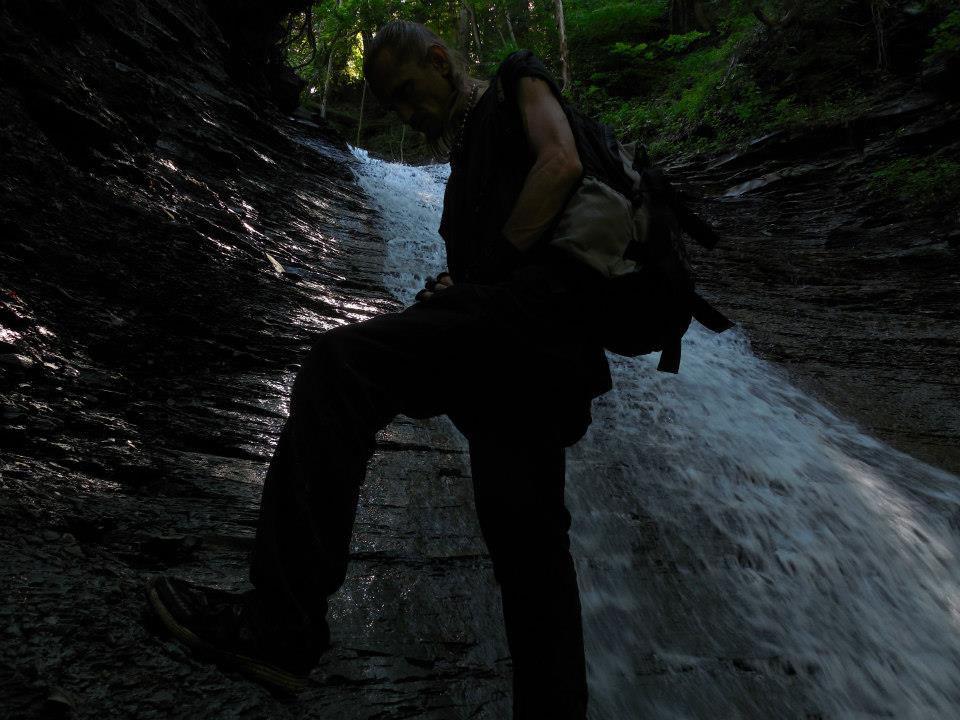
Time and the Sister of Fate played a role in causing me to break my promise to Hera that the final votive would be placed upon the Summit of Sacrifice last year. Before I can attempt to do so again I have to pass the test of The Furies by traveling to the peak at the center of the crater and obtaining an artifact from their temple. One that they have no intentions of allowing any mortal to have.

There are other dangers to this next journey aside from the Furies themselves. The area is said to be plagued by melon heads. According to local lore, the melon heads were originally orphans under the watch of a mysterious figure known as Dr. Crow. Crow is said to have performed unusual experiments on the children, who developed large, hairless heads and malformed bodies. Some accounts claim that the children were already suffering from hydrocephalus, and that Crow injected even more fluid into their brains.

Eventually, the legend continues, the children killed Crow, burned the orphanage, and retreated to the surrounding forests. The same forests where I must travel in order to get to the crater. 


I'm not the only one in history to know of the powers of this forest. Berea sandstone from this place was taken to build the foundations for many local buildings, including the Kirtland Temple, which was completed in 1836 after a man by the name of Joseph Smith was reportedly visited by "an angel" who directed him to a buried book written on golden plates containing the religious history of an ancient people. From the temple built of these stones rose the Mormon faith and the endeavor to build the city of Zion - which never happened. (On a side note: Lindsey Stirling, the violinist who opened up the second season of The Journeybook and has appeared in several of the videos just so happens to be a Mormon herself. She is also one of the sweetest people you could ever hope to meet.)

And so the plot thickens as the final battle with Zeus comes ever closer.

The Fountain of Neaera


To the north, near the shoreline, there is a winding path that runs along a creek, 'round a lagoon, and into a garden that is warm and bursting with life no matter the season. At the center of this immortal garden rest a fountain belonging to the nymph Neaera. And there, hidden in among the forever blooming flowers, is also an effigy of Pan who is said to frequent the garden himself to gather drops of the enchanted water.

I'm set to travel to this garden tomorrow in order to collect a vile of the same waters and bring it back to the Altar of Hera. The vile of water from the Fountain of Neaera is but one ingredient in a potion that I'll write of later.

The coming adventure is in stark contrast to the rusty, drab landscape seen when obtaining the Hammer of Hephaestus. The forested path and hidden garden are the personification of the enchantments (and dangers) of classical beauty. It is the type of place that inspires lamenting poetry, where travelers begin to dream dreams and see the apparitions of loves that never existed and almost were. The type of place that assaults the heart and lulls the soul with sweet music. Enticing one to lay down and sleep in order to dream until death. An enchanted isle of precious moments, as intoxicating and warm as the arms of a beautiful woman.

Neaera's enchantments over her fountain and the garden that surrounds them manifests as whispering voices on the breeze, hidden, illusive, as if it were the flowers themselves that were quietly singing the gentle lullaby. Makes the mind wonder of hidden mysteries and soft, delicate shadows. Makes the heart aches for hearth and home. But also awakens something much more primal deep within the soul.

Neaera's smile sets fire to the resolve of men. Burning them up from the inside out. They see her reflection in the waters of the fountain. So crisp, so pure. They feel an overwhelming need to run to her, to embrace her, to feel her warm touch. But the pool is unforgiving, unkind, cold. It breaks the apparition with icy fingers and those who have lost their hearts to fair Neaera drown in their sorrows long before they drown in the liquid crystal waters of the fountain where their dreams appeared so clearly.

No fault to fair Neaera for the weaknesses within the hearts of men.

How often are such themes repeated throughout myths and the world? The dangers of beauty and the downfalls brought forth by lust. It was even the downfall (and rise) of Great Pan who's honor and effigy I will also capture on film within these gardens. There is no heavenly light so pure, nectar so sweet, nor poision so deadly as that of a beautiful woman. That kind of undeniable beauty that invokes both passion and hatred, weakens and strengthens, offers hope and can take all hope away. It can make the souls of men immortal, their power otherworldly. And in the very next moment, can scatter them like burning leaves.


Beautiful, intoxicating, fair Neaera who's enchanted fountain is the sum of infinite kisses and the long warm embrace. Kind only to the heart that's true, honorable, worthy. Who's will is stronger than the fires of lust - to be cooled and tempered by the icy spring.

To such she grants her kiss, her blessing, her healing touch. One small measure is all that is required. Drops and nothing more to carry one through for the rest of their days. Ever remembering the dream, forever feeling the glowing warmth from within.

A nymph to be sure. Full of allure and desire, passion and love. A magical creature as is any beautiful form that inspires poetic notions and life itself to burst forth around it simply because life itself feels that same primal pull. Always hungry, always needing more, always desiring to be ever closer to that golden glow. To feel the warmth of the sun reflected off of her skin, to feel the light that radiates only from her eyes, to feel the entire world soften at her slightest touch, to know the unspeakable meaning of love - found only in a kiss.

Dangerous.
Vital.

A long embrace before the long journey to come.


For Glory

As eventful as writing this story can be, more times than not weeks will pass before there is really anything worth recounting. This is not the telling of a tale that is based on a singular experience or muse. It didn't happen "one day" or even over the course of a few months. It's been going on now for years.

But, in all of that time, I have never hesitated or lost the motivation to keep going. It's become part of normal, everyday life. Ingrained into everything from work to play. Always there, always happening bit by bit.

It has made life more interesting and colorful. No where near common, never dull, never mundane, hardly meaningless. There is suffering, hardships, wounds and scars. There is the outcastishness that comes with the part. Stories for blogs and private journals. Never really fitting for idol conversation over coffee. Entertaining in one light I suppose. The Journeybook interactive page where the video series is primarily presented remains active enough. The video collection for this very story alone contains nearly 90 entries with viewers daily. They read, they watch, they remain silent.

It is a rare thing in the pagan community to see stories such as this. The ever growing number of people who lay claim to a connection with old gods. Most of them lost, confused, alone. Searching for some sign of hope in a darkening grey world. Sad, shallow, half-hearted efforts - no stories to tell.

The Spring rains have come, slowing things to a crawl, reminding me of how exhausted I am. The kind of exhaustion that only the path can bring. A kind that sleep will never resolve. A long road traveled, the end still far away. The exhaustion comes from that knowing. A constant testing - the gods asking how deep your faith goes, how boldly you might back your claims on them. Many fail the test.

They comes into this with all of the energy and passion of a renewed soul. They burn out quickly. They don't have it in them to endure, to remain focused, to stay driven. They still make there claims but there is no longer effort there. No more rituals, no more energy, nothing left to say, no will left to search. They fall silent, apathetic, forgotten.


Daily - the candles are lit, oils and incense burned, new votives offered, weapons sharpened and polished, stones carved, maps studied, pieces written, photos taken, video edited and presented to the eyes of the world. Every day, year after year, tale after tale even when there is no tale to tell. Amidst it all - time capsules, most made by and for whatever community I might find myself in. I travel to them, add in tokens, letters, pieces of this same story that will not be seen by mortal eyes again for another 200 years. Long after I am dead and gone, long after this very recounting and the video documentations cease to exist less it be recreated over and over again by the hands and voices of someone else.  But the stones were carved, tantalizing pieces locked away. Luring, enticing, full of questions and wonder. An investment into the curiosities of men. A thought that what we do today will be the myths and archeological quests of the future.

A farm boy who became a pagan king. A king who defied a God for the love of a Goddess. A journey spanning thousands of miles full of beasts, magic, mystery, unexplainable manifestations, mortal wounds, and epic victory.

Classic. Timeless. Immortal.

A life well spent. 

Even as I am writing this hundreds of new photos from this story have been sent out into the world in different places and left to the imaginations of whomever might lay eyes on them. From there they will spread out. Copied, shared, renewed over and over again with no further effort on my part. an advantage of the technological age. easy today to scatter the pieces like leaves on the wind until they encircle the entire world.

And then there is you, dear reader, who happened upon this be either chance or destiny and have read this far from whatever distant land you are in. I will show you things you have never seen before and never will again. You've discovered a tale that will never have an ending even if I were to die today. I've already traveled too far. Death would only deepen the tale.

Bound in mortality and  life, by year's end I will still hold lightning in my hands and the event will echo like thunder. I will have turned rain into wine and drink of storms from my cup. I will have put my pagan crown up against the might and will of Zeus and I will have defeated him. I will do all of this in front of a live audience who will witness and be a part of each step in the journey. I will present it to the eyes of the world in every medium. I will be filled with pride in the accomplishment.

And then, I will still have to go back to doing dishes, laundry, cleaning my house, and pretending to be a normal guy... as best I can.

Winter will come again. The months of questing over for a time. And in those dark winter months I will grow restless and begin to dream of adventures once more. This is the path and the life it brings.

Endless. Everlasting. Renewed like the seasons themselves.

A beautiful, glorious life. Too rich not to share.

The Hammer of Hephaestus


"Hard to fight the Olympian strength for strength."
Hephaestus, The Rage of Achilles, p.IXV II 


And so it was that the journey continued onward, heading first north through the valley of forges. Many of which have long since been abandoned and left to ruin. A rocky, reeking, poisoned, narrow stretch of land, stained in the blood of iron itself, going on for miles. Hard to travel, harder still to capture.

It was in this vile valley where there lay an island of ivy beneath a high bridge, just to the east of the river. Into the ivy a concrete stairway with crescent moon landings and there at the top, silver and shining with a gleaming black handle lay the Hammer of Hephaestus which in its hard kindness brought brilliant color to the landscape.

Why north when the ultimate goal lay far to the south? Far down the river valley, beyond that great waterfalls where the Sisters of Fate dwell, far beyond the climb and deep into the forested ancient sea bed where the earth itself was ripped apart in some ancient battle with the elements and never ending pull from the heart of the earth. Why north? Why this wretched valley of iron and waste to claim a forgotten hammer of the lame God? 

"Hard to match the Olympian strength for strength." Hephaestus said. It would take more, much more and as the journey continued Zeus himself made it a point to have his attentions felt. Conjuring up day after day of thunderstorms and hard rains. But he had manifested the tempests too late, his move was seen before he had made it. 

North, beyond the iron valley of the forges, lay a long stretch of blessed green where garden after garden, full of fountains, flowers of every kind, and ancient trees represent the great nations of the world and the many cultures that came to tame this land. It is in the stretch of life where rests a garden crafted by Greece itself. 

Two Doric columns frame the garden's entrance, opening into a plaza containing a reflecting pool, offering a perspective on a wall and pylons, which symbolize the wall of the Parthenon. Stone tablets on that wall and pylons are inscribed with the names of prominent Greek artists, philosophers, writers, and scientists: Solon, Ictinus, Callicrates, Phidias, Aristophanes, Pericles, Euripides, Sophocles, Aeschylus, Homer, Praxiteles, Zeuxis, Apelles, Myron, Lysippus, Scopas, Sappho, Socrates, Anaxagoras, Aristotle, Plato, Aristarchus, Demosthenes, Pindar, Archimedes, Herodotus, Xenophon, Thucydides, Euclid, Hippocrates, Ptolemy, Pythagoras, Polycletus, and El Greco.

Framing the symbolic wall are two paths that encircle it, leading to sandstone terraces, lavishly planted with ilex, coloneastus, myrtle, and sweetbay, with cedars and Lombardy poplars giving the impression of cypresses. 

The Hammer of Hephaestus is to be taken there. It's strength combined with the sacred waters of the fountain and a three measures of the blessed waters taken. The first measure it to be brought back to the Altar of Hera as a votive offering. The second measure is to be used in an ritual anointing - to make the flesh strong, the will - hard as iron, and award strength as fierce as the Hammer of Hephaestus itself. The final measure is to be placed in the altar room until the final journey is to be undertaken. Cool, healing waters imbued with immeasurable blessings to aid in the quest.

The journey is taking us counterclockwise around the 60 mile radius of the stone votives circle cast last year. Symbolic of traveling back in time, relearning, gathering strength, increasing endurance, making amends for the past defeat. A test of the will, a test of the heart. Long, hard, exhausting. But not so much as the long path that lay behind - the year after year of this singular theme that began with something as delicate as a feather. 

A long way left to travel with every step in defiance of Zeus, weakening his ancient bond on Hera. Zeus takes note, sends forth his storms, thunder, and lightning. And with the coming of the torrents a crystal bowl, taken from the Altar of Hera is placed in the rain. A single measure for each storm cast - taken and placed bowl by bowl, storm by storm, into a sacred vase. Once full the waters taken from Zeus's storms will be combine with the waters taken from the garden fountain, transformed, turned into golden honey wine - lightning and thunder in a bottle. Seal with blood red hard wax and presented to Hera. 

The journey, the sacrifices, the votives, the recounting of the tale for the eyes of the world to witness old Gods on new streets - Hera grows stronger with each tribute and Zeus weaker with each step of defiance. His conjurings and manifestations shrugged off, claimed, bent and twisted to advantage. Cunning, peerless, unheard of in the modern age. 

A fitting end.


Rise From The Ashes


When Zeus took it upon himself to interfere with the quest to break the bonds of Hera the world watched as the quest ended in defeat at the very foot of the forested hill where the final Heraian Votive was to be placed. But in spite of the astonishing manifestations and actions of the King of the Gods this would not be the end of the journey to release the Goddess from her ancient binding.

On March 30, 2013 the quest began anew and The Journeybook chronicled the rise from the dirt and ashes of defeat, great sacrifice, and a climb out of the river valley where the new story was to find its beginning.

The bridge in time between the defeat and the rise landed me on the very river bank where the bronze statue of Hera is taken on the Spring Equinox every year to be washed in the waters of the river.

Defeated, covered in dirt and rubble, it was necessary to offer up sacrifices in the form of ash and flame.


Sacrifices to the Gods must be something of rarity and value. It is the very definition of the word 'sacrifice' - to give up something of worth. As an offering to Hera in light of the defeat the altar ash, collected from the votive burnings in the Altar Room over a three year period were given up. Mixed with the dirt and rubble in the opening sequence of The Ashes of Prometheus Video. At the same moment, off in the forest, an iconic blue rose waited alone in a landscape that had been laid to waste by a massive flood. The tress splintered and strewn about, the land covered in a think layer of sediment and sand. The blue rose was the only color in this dusty and drab landscape.

Like a phoenix, as I rose from the earth the blue rose began to burn. A life for a life. The great symbol, reaching far into the past, was taken by flame so that a new flame could be lit from its sacrifice.

As the flames consumed the blue rose, unleashing its memory and power, the renewed quest to finish the long, complex ritual to free Hera and defeat Zeus began. And what would rise from the ashes of sacrifice was something new to this story. Something that Zeus himself knows all too well...

 ... the power of vengeance.

Sacred Spaces - A Peek Inside My Altar Room


(Doorway to the Altar of Hera)


(The Altar Room)
Recently, in the Den, Zech brought up a great topic on the differences between indoor and outdoor sacred spaces. I consider myself extremely lucky to have the best of both in the most serenity filled room of our home and I thought I'd take the opportunity to give everyone a peek at some of the things inside my altar room.

Above is a photo of the double folding glass doors that divide the Altar room from the rest of the house. It is located On the south side (front) of the house, extending the front wall to the edge of the front porch which is to the left of this photo. Just in front of the photo is the front primary flower bed which also holds herbs, three watermelon vines, is backed by a panel of purple morning glories and crowned with 5 lilies. At the back (center) of that flower bed stands a large peacock. On the west side, tall ivy and flower vines cover the west wall and the edging is allowed to grow wild to help support the birds, squirrels, and the groundhog that lives under our neighbor's front steps.

The room itself sets just over 4ft above the ground with a large crawl space under it that is accessible through a hinged panel on the west side of the house. The loose sandy soil that lies beneath the Altar Room is the most likely place that someone in the distant future will uncover hand engraved stones that offer names, dates, and one to two line fragments of story referencing old Gods, magic, and immortality.

The East, South, and West walls of the room are primarily made of panel windows that open in the same manner as a cupboard door with the original latch locks on both the top and bottom of the windows which opens three entire walls up to the outside and offers direct light any time of day (or moonlight by night). And the North wall hosts two 3 foot solid strips of wall before breaking for the wide double doors that lead into the shadowed living room that is decorated in antiques, family photos, and accented with glass tables, crystal, and bronze.

(Greek Treasures)

Philosophers and sages throughout the years have played with attempting to describe metaphysical connections to lands we have never stepped foot on. And I have a few of them, all of which are located in central or western Europe. A remnant of a past life, an illusive dream, unbreakable bonds with the people I have met there, or something mused into my mind and heart from a mundane source...who knows? The point is not in the knowing but in the enchantment. And, for me, these lands are enchanting. The way they once lived, the modern approach to life in general, the poetic notes that changed the world over dozens of times all came from here. And any time I get the chance to get something from this land I tend to jump on it. If it was hand made and imported (or otherwise inspired) from Greece I want it in my Altar Room. Having those pieces of the land itself is somehow important to me and makes the illusive dream of what once was seem more real--physical links in a stronger chain of connection with the homeland of my patron Goddess.

This "chubby Pan" statue was one of the first things inspired by Greek myth that I was gifted.

My mother actually received this statue from my Elementary School Principle who had been following a pagan topic newspaper series I was writing back in 2002-2003. The newspapers came to call the nearly 100 editorial series "The Year of the Witch". It was the first time in local history that pagans seemed to be coming out of the woodwork and "witchcraft" became a common and locally excepted word. The public loved following along with the series in the two local newspapers and sales of those papers went up almost 18% during that run. The series is kept safe now on microfilm in the local library's Heritage Room as well as the county museum.

The statue was a gift from my old 5th grade teacher and Principle for a job well done by way of community involvement and education. She said that I had "turned into the teacher". Which was a nice sentiment. But, my mom being my mom refused to take the statue from her for nothing. So, she gave her 50 cents for it. Today, this same statue retails for about $100.00 unpainted.


This cup is one of two 24k gold trimmed, hand made cups that rest on the Altar itself. They are the very first actual imported items I ever received.

I came across these at a yard sale and bought them both for $2. After a meticulous cleaning and cleansing the cups became side pieces for my Altar over the years.

They have thick bottoms that make them heavier than they appear and are numbered. On the bottom of the cup is a decorative bordered "S" and they read "Hand made in Greece in 24k Gold". I have number 8 and 14 in the collection along with a matching small vase that is simply numbered 124.

The only time that I ever actually use these cups is for extremely special and rare occasions and the only thing that ever goes into them is sweet dark red wine (which is rare in and of itself). One cup goes to me and the other to Hera. Her's will rest on the Altar for a bit before being poured out into the earth in offering.

This is Hera's "Tiny Treasures" Offering Plate. The plate is milk glass, trimmed in gold, and has a wheat pattern gold ring surrounding its center.

Wheat was referred to as "The flower of Hera" in the late Bronze Age, for some reason that eludes me because I don't consider it a flower at all. But who am I to argue with the ancients?

The milk glass itself is sympathetic to the myths of Hera nursing mortals and demi-gods such as Hercules and Achilles to imbue them with her power, or as in the case of Achilles, her rage, which is one of the blessings that made him such a great warrior.

On this plate is where I place items such as river stones, polished glass from the beach, bits of pear or willow bark, flowers, or any other tiny treasure I might come across on one of my many adventures.  It is also where I place the two necklaces I never leave the house without every night before going to bed. And always present at the center of the plate is the red box that holds "The Eye of Hera" itself from many of the Denian Myths that you can find in the Den Archive.

"The Wings of Icarus" -- A gift from my beloved Braegan, are proudly displayed on the east side of the north wall of the Altar Room. Every "Angel" should have wings right?

In the Myths, Icarus was the one who was linked (along with his father) in creating the Labyrinth of the Minotaur on Crete. Both were imprisoned by King Minos and Icarus's father fashioned two pair of wings to help them escape.

But, despite being warned, Icarus flew too close to the sun and it melted the wax holding the wings together. Thus, he plummeted to his death. His wings are a reminder of the hidden dangers of being over-ambitious.

On the opposite wall of the Wings of Icarus rests this newly included hand painted copper plate. Another actual imported item that was made in the 1950s.

We found this item just this past weekend while we were out on one of our adventures. I thought it was proper to have a hand made Greek import displaying a Greek Temple in the Altar room. Can't get much closer than that! And the common decorative border on this plate also matches the border on the gold cups and vase that rest on the other side of the room.

This Greek style plaster column rests on the left side of the Altar itself and is a display of simplicity.

For some reason the colors: purple, white, pink, yellow, blue, and gold have always been present somewhere in my dealing with Hera.

The peacock feather accent is common throughout the room with a total of 7 peacock feathers and one statuette present near or on the most sacred items.Two rest on the Altar itself which I cannot display here.

The notion behind the peacock feather relates to the Myth that Hera placed the eyes of Argus (Hera's hundred eyed giant) into the feathers of one of her favorite birds.

Argus was Hera's "spy" and whatever he looked upon she could also see. So, by placing peacock feathers in the Altar Room (or anywhere else in your home) you are pretty much offering the Goddess a free peek at anything that goes on there. Here, Hera's eyes are always watchful.

This is Charlotte, my 11 year old rose haired tarantula in her newly designed "Sisters of Fate" inspired tank.

Charlotte is the spider priestess of the Sisters, spinning, measuring, and cutting her silken threads of time and fate over green glass decorative stones, a small Greek vase, the "Sphere of Time" (which was my very first scrying glass) my gold "Time Teaser" necklace that is inlaid with crystals surrounding a clock face, a golden ring that I discovered on one of my adventures, and another necklace that was a gift from one of my own three sisters.

This many eyed, stinging haired, nearly one inch fanged guardian of the time treasures is a constant muse and aid in many of the things I write, spin, and plan in both the Denian Universe and life in general. A reminder that the past sometimes weaves the future.

These are just some of the many items in my Altar Room dedicated to Hera and it is added to, cleaned, cleansed, redecorated, and visited on a daily basis for the burning of candles and incense. The room is also home to three potted plants, has a scattering of sea salt and white sage in and on nearly everything, has a place for putting coins to be tossed into the river on certain occasions for certain things, an antique trunk where I keep all of my hand written journals and favorite books, a chest that holds rare photos of my son and daughter, and so many other hidden wonders that it would be nearly impossible to put into just one blog.

All of this in the love and service of the ever present and rather over-protective Queen of the Gods who has guided and empowered me so that I am able to do all the things that I do. The more I learn about her the more I learn about myself. This Altar Room is the sacred testament of an epic life, a legendary journey, and an ancient Goddess walking new streets.

Today, just about everything that I am able to cook up for the Denian Universe is mused or conceived of in this one room. Both Braegan and I are extremely protective and territorial of this room. Visitors have access to every other room in the house but this room is a different matter entirely. We have only allowed family members in here twice and they are about as far as you can get from being pagan. But even they describe the smell and feel of the room to that of a church. And coming from non-pagan people that is about as good as a compliment as you can get and  sign that you must being doing something right. No matter what the path or what one believes there is something spiritual here. And it has been nothing but a blessing that permeates every aspect of our lives.

Blessed are those in the eyes of the Gods -- Pitied are those that need them.

Into the Wild


The impact of the Panhellenic mind set and Homeric reconstructions of the Iliad has nearly completely crystallized the modern view of Hera into a figure the ancients never really considered. Her life was far different from that of the modern interpretation which is often based in Homeric poem rather than actual thought and practice.

The Panhellenic social mind set was based in subordination that needed a general metaphoric patriarchy which a retheologized Olympic family could offer. In doing so, the Panhellenic myths were the first step in setting Zeus upon his throne and, in turn, the male as the head of household.

Before Hera was retheologized near Argeia to better fit into her new mythic position we can look to the temples in both Samos and the Delian Heraion where admittedly very little of the mythological lore still exists, however many of the votive offerings to the temples do. Of which are figures of wild animals including: sphinxes, lions, griffins, birds and others that stand in contrast to something befitting the newly cased Olympian Queen and lends more to her original role as a nature goddess and mistress of wild animals as she was in the Mycenaean past.

Athena would later be gifted another of Hera’s original roles as the goddess of the shield and citadel. Most likely a new Athenian sphere of influence due to her Iliadic functioning as Hera’s agent and Hera’s battle Goddess in Argolic myth that transferred over into the Panhellenic myths. Since Athena was the daughter of Zeus the new position subordinated the sphere of influence over war to her father, increasing his own influence and supporting the masculine drive of mortal society.

However the reconstructions may have developed the Mycenaean view of Hera still persisted in many areas and held her as the goddess of untamed animal life, war, and the house, as well as a Spring Goddess of general fertility still worshiped at her tree and bathing in the river, who had the power of life and death over “heroes” - those who won fame from Hera.

Still, as time went on and people began to sway to the new theology, Hera began to lose her power bit by bit. The time when this really began to take hold in Greek consciousness is still shrouded in mystery. Slowly Hera’s connection with the natural world, her sovereignty over life, her influence in war, and her association with tree and river cults began to diminish as she was forced into the suppressive role as a goddess of domestication, subservient to her would be husband. A mortal theme that would last for thousands of years in western culture and is sadly still purported by the majority of writings regarding Hera today.

All of the evidence suggest that Hera was once the dominant Goddess of the pre-Olympian age. Her Hekatombaia that was celebrated in the Archaic Heraion was a New Year’s festival that presented her as the Goddess of Spring and new life, mistress of wild animals, and tamer of the untamed come winter and death; offering context to her non-Homeric description: teleia - “fulfiller”. There is no real evidence beyond the Iliad that suggest Hera as the subservient wife of Zeus or that the two figures had any connection what so ever within the mortal social sphere or in worship.

The sin of the Homeric patriarchy is that it has empowered one sex at the expense of the other. In order for the male to take the role of dominance all of the feminine influences had to be suppressed. Which, above all others, included Hera because she was the dominate feminine with an unprecedented power over her male counterpart in the Pre-Panhellenic world.

Hera was Queen long before Zeus was King. That fact could not be allowed to hold if men were to take full control over hearth and home. It’s a theme that has lasted to the modern age. Even the theology of Christianity has dominant male themes and “tames” the power of women.

Yet, in spite of the mortal habit of reflecting their social whims upon the Gods as a way of justifying their animalistic behavior, Hera remains untamed. She did not yield to servitude or suppression even in the Iliadic myths or in the light of her most often portrayed personification.

In the eyes of mortals Hera may not be commonly viewed as the seasonal mistress of wild animals, the bringer of new life, a goddess of the shield (war) and citadel, or the protector of the home. But the truth will forever outshine their confabulations and misrepresentations that serve only their petty whims. Whims that are easily cast aside once one travels a little deeper into the murk.

Feast of Dreams


“Philotheros [lover of the wild], I desire to feast, not in the city, but at Hera’s shrine, enjoying gusts of the west wind. A linen pallet on the ground beneath my body is enough for me—a bed close by a native tree (promalos), and a willow (lugos), ancient wreathing (stephos) of the Carians. Let wine be brought and the Muses’ charming lyre, that, drinking to our hearts content, we may sing of glorious Hera, mistress of our isle.” (Nikainetos quoted by Athenaeus 15.637b-c Kaibel 1890)

Nikainetos was a poet who lived in Samos in the 3rd century B.C., around 290 B.C. and is often included as one an Abderite, a student of a pre-Socratic school of thought that was founded between 440-430 B.C. The fragment above helps to illuminate a more fragrant view of the sociology surrounding the Temple of Hera and how is was likely a common practice to lounge about the Temple feasting in merriment until lulled off to sleep on a convenient pallet, bed, or couch there on the grounds, to dream dreams and have divine visions of the Mother Goddess while resting there.

One can’t imagine that the noise, smells, and hustle and bustle of city life offered much by way of peace and divine dreaming. Before all Hera was a nature Goddess with rituals founded for river gods and votives proper for a deity of both protection and fertility, the latter extending to crops and the renewal of life from death as a Goddess of Spring. She was also held as a mistress of wild animals that included griffins, oxen, horses, lions, and several birds. And in as many as twenty separate cult houses, throughout time, there is solid evidence that Hera was the Goddess of hearth and home. We may also allude to Hera’s Rite of Spring and the conclusion of the cycle in the autumn with The Harvest of Hera; a seasonal pattern that illustrates the notion that the giver of life (The Earth Goddess) also takes life away. The same notion can be seen in the mythos of “hero”, (Hero/Hera – Those glorified through Hera) who almost always died a young death.

Hera was the most influential and honored at one point in time while Zeus, who many attempt to place above her, can be viewed as a paranoid degenerate whose life and actions only served to back that point of view. His mortal gifted esteem and position was granted primarily by the sexist feminine suppression and social upheaval of Homeric times. Where Zeus was all force and chaos Hera was nurture and serenity; attributes typical of a mother goddess. And so, it is to the Temple of Hera where one ventures to find peace and simplified comforts of life.

It does not take a stretch of the imagination to see a clear vision of what a common Temple visit would have been like. A visit based in relaxation and merriment honoring Hera until one is mused to curl up on a soft pallet and be lulled into dreamful sleep in the arms of the Goddess herself with a belly full of food and drink that only serves to allow Sleep to visit more easily and dreams to become much more vivid.

How many visions came to the minds of mortals in such a manner? How many hidden, subtle blessings to the minds of men; to muse and encourage a much more rustic existence than anything we may experience in the modern world, still with all of its grit and grime. It’s so easy to slip between silken threads to touch the divine, so easy to find the sense of peace to the depths of the soul…and so easy to deny it all in the here and now. Perhaps we have forgotten what is important.

So, we come to the Temple of Hera to feast, sleep, and dream on a common day with common foods. What we might find there are things such as: arugulas, cucumbers, artichokes, cress, fennel, radishes, squash, grapes, olives, figs, pears, plums, apples, pomegranates, peas, lentils, sardines, an array of sea foods, goat, goose, boar, chicken, deer, rabbit, lamb, a variety of breads, and the fragrant bergamot oranges that, today, the essence of which is commonly used in the making of Earl Grey tea. All such foods may be seasons with things such as pepper, dill, salt, thyme, saffron, coriander, mint, and oregano.

Bread was a staple in ancient times with the inclusion of a small amount of vegetables, olives, and wine incorporated into everyday consumption. All of which was eaten by hand rather than with utensils. Raw fruits and olives were common as side dishes with any regular meal and often that meal was not a “fancy feast” but a feast of simplicity. It was perhaps an unrealized effort to take something really good and not screw it up.

All of this there in the cool shades of Hera’s Temple, a wide open space beyond highlighted by pools of golden sunlight. The soft caress of the west wind mixing and mingling the scents of the foods and the Temple together into a new form of ether unique only to that moment. A ghostly, fluid, lubricant that allowed one to slip from mortal form and into something more, however briefly. A simplistic feast set in the divine, an afternoon nap in the lap of a Goddess…a slow, steady, nurturing, and stress free life full of magic, mystery, and wonder known only to those who, with bellies full, dream.

How quickly mortals forget.

Followers